A subsurface structure can look very different through gravity,
magnetic, electrical, and seismic measurements. Studying these
views together calls for data that share the same geological
context.
GEMS-3D pairs three-dimensional property volumes with observations
from all four modalities. Spatially aligned properties, anomaly
labels, and acquisition metadata connect physical structure to its
observed signatures.
Use these paired representations to study supervised forward
surrogates, joint property reconstruction, anomaly recognition,
and robustness to incomplete observations.
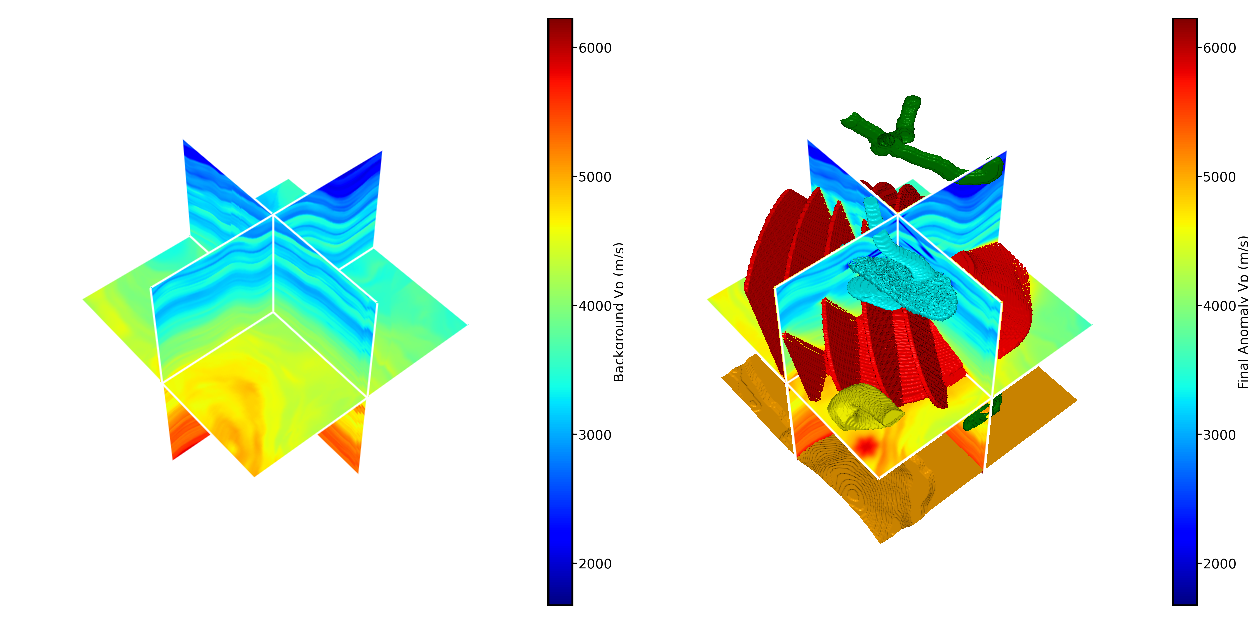
Geological diversity
Igneous intrusions · Gas & hydrates
· Brine faults · Sulfide bodies
· Salt domes · Basement interfaces
· Serpentinized zones
02 / Research figures
See the science, side by side.
Explore original figures from the research manuscript. Enlarge a
figure to read its labels and compare the details.
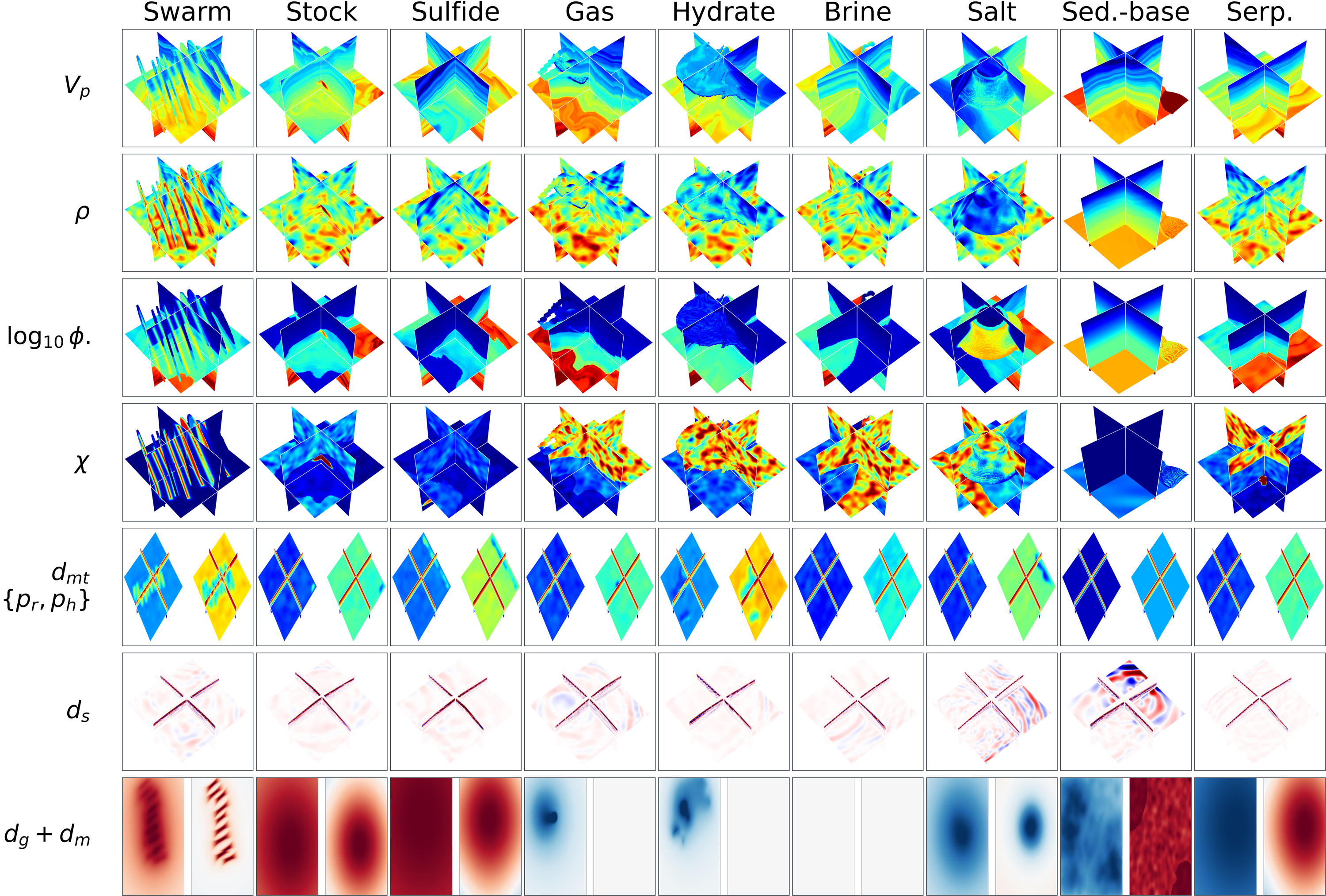
Nine geological families, viewed across aligned properties
and observations.
Representative samples from the manuscript. Columns show
nine anomaly families. Rows show velocity, density,
log-resistivity, susceptibility, MT, seismic, and
gravity–magnetic responses. Colors are specific to each
panel.
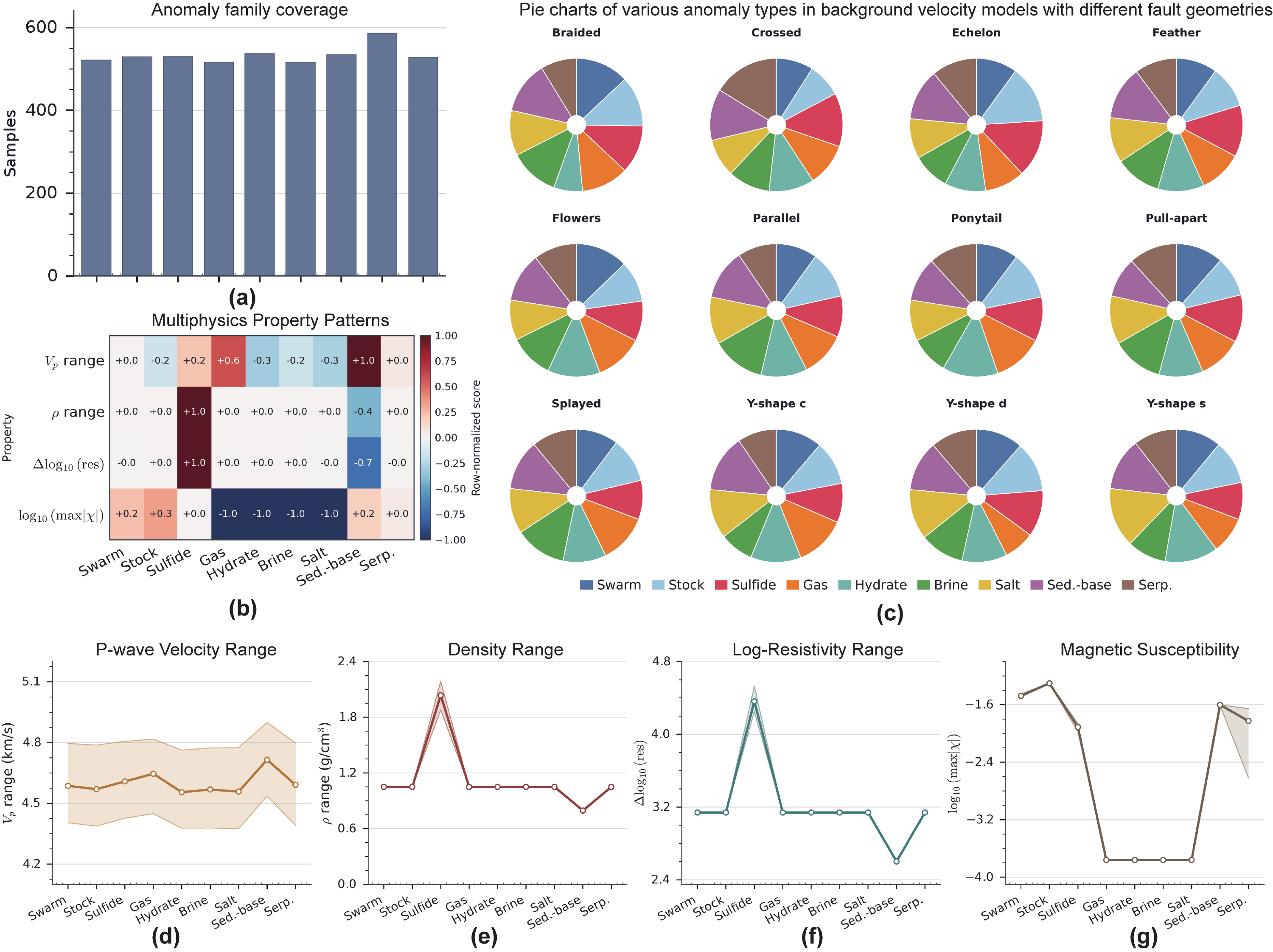
Geological diversity and distinct property fingerprints.
Model-side diagnostics from the manuscript: anomaly-family
counts, row-normalized property signatures, coverage across
background fault-structure classes, and family-wise property
distributions.
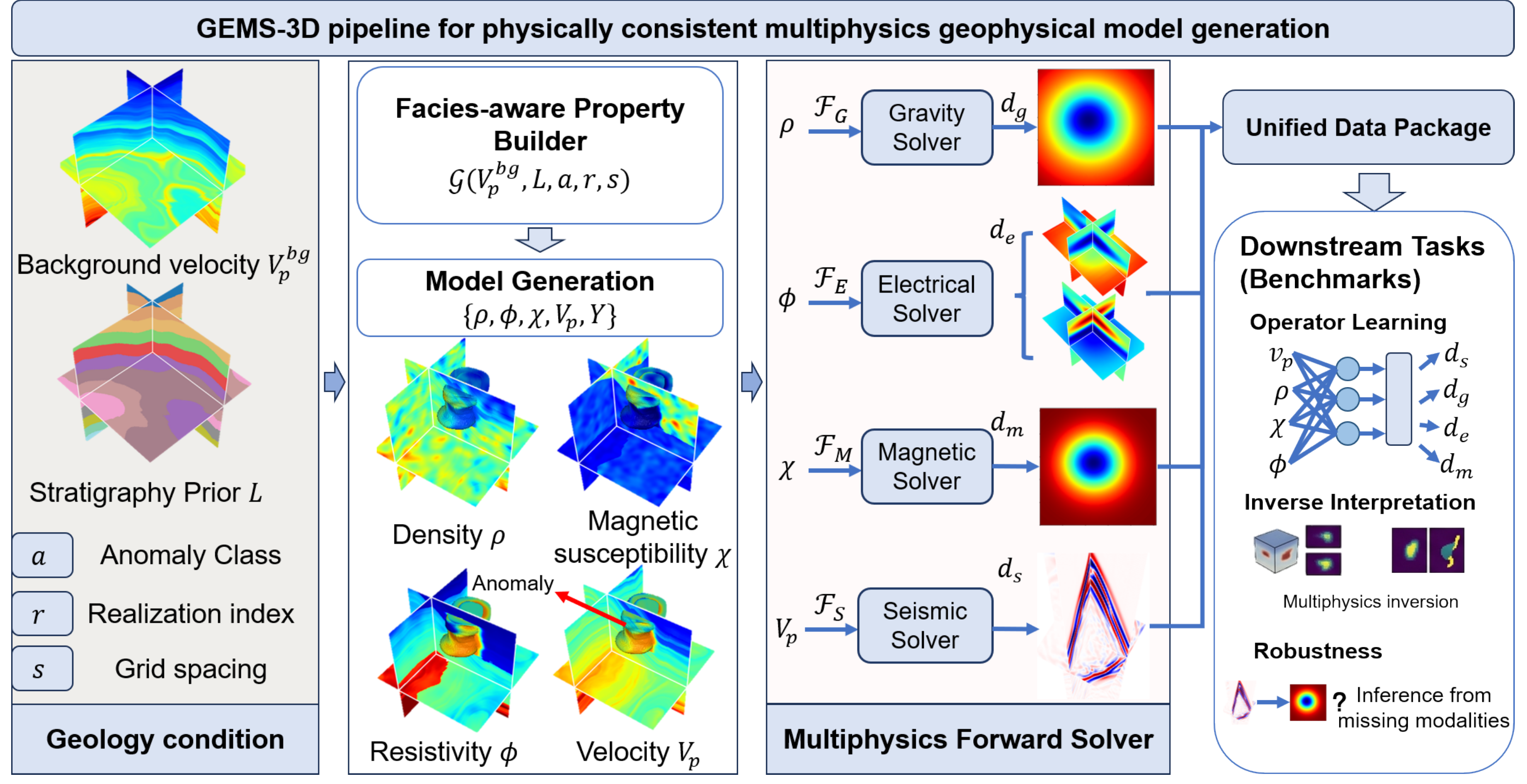
From geological conditions to aligned multiphysics data.
The manuscript’s dataset pipeline connects geological
conditions to aligned velocity, density, resistivity, and
susceptibility volumes, then to gravity, magnetic,
magnetotelluric, and seismic observations in a unified data
package for downstream benchmarks.
Choose a modality to explore its property volume, observation, and
fields in a prepared sample.
3D propertyDensity ρg/cm³
⟶
ObservationGravity anomalymGal
Connect the distribution of subsurface mass to its gravity
signature. Pair a density volume with a spatial observation grid
for supervised operator learning.
Property field
rho_model
Observation field
gravity_data
Representation
3D volume → 2D grid
3D propertySusceptibility χSI
⟶
ObservationMagnetic anomalynT
Study how magnetic susceptibility contrasts appear in surface
observations. Shared geological context lets magnetic signatures
be compared with the other physical views.
Explore the electrical view through frequency-dependent apparent
resistivity and phase. Frequency metadata and polarization
channels accompany the prepared observations.
Property field
res_model
Observation fields
mt_app_resmt_phase
Frequency axis
mt_freqs_hz
3D propertyP-wave velocity vpm/s
⟶
ObservationSeismic gathersShots × receivers × time
Relate velocity structure to time-dependent seismic
observations. Source and receiver geometry retain the
acquisition context for studying individual shots or joint
predictions.
Counts and sizes follow the linked release cards. Review each card’s
metadata, manifests, and license before use. Even Tiny contains
approximately 20 GiB of data.
06 / Get started
From a prepared sample to your next experiment.
Download the data, inspect a bundle, and build on the open
benchmark loaders and models.
import numpy as np
# Use a trusted, downloaded dataset sample.with np.load("path/to/model_bundle.npz",
allow_pickle=True) as sample:
vp = sample["vp_model"]
rho = sample["rho_model"]
res = sample["res_model"]
chi = sample["chi_model"]
print(vp.shape, rho.shape)
Aligned volumes. A shared sample. Four physical properties.
The public benchmark release uses prepared data. Geological model
generation and the numerical forward solvers are maintained
separately.
07 / Reference
Building on GEMS-3D?
Reference the public dataset release when using the data. This
resource entry points to the dataset card; consult the card for
bibliographic updates.